Greenhouse Gas Mitigation
Premier Marketing Public Company Limited and its subsidiaries recognize the significance of climate change and are expanding their approach to energy management and global warming mitigation to effectively encompass the entire business value chain for maximum benefit. Their operational guidelines include conducting business responsibly to mitigate global warming and managing energy sources such as electricity, water, and other renewable resources. The company promotes and encourages all departments within the organization to improve energy efficiency in their operations and business activities, while also promoting the responsible use of natural resources to maximize efficiency. Furthermore, they are committed to developing innovations and measures to reduce overall energy consumption.
Energy Management and Climate Change Mitigation Policy
Premier Marketing Public Company Limited and its subsidiaries recognize climate change as a critical international agenda item that impacts the economy, society, and the environment. Therefore, the company is committed to conducting business responsibly, prioritizing approaches to mitigate global warming and manage energy sources such as electricity, water, and other renewable resources. They are expanding the concept and management of energy and global warming mitigation to effectively encompass the entire business value chain for maximum benefit, with the following operational guidelines:
- The company promotes and encourages all departments within the organization to improve energy efficiency in their operations and business activities, while also promoting the responsible use of natural resources to maximize efficiency. Furthermore, they are committed to developing innovations and measures to reduce overall energy consumption.
- The company sets targets for reducing energy consumption, including continuously monitoring performance and comparing it against established goals, such as setting targets for reducing electricity, water, and paper usage.
- The company improves its waste management processes by implementing the 3Rs principle: Reduce unnecessary resource use and consumption, Reuse resources to maximize their value, and Recycle materials to decrease waste volume and reduce the release of pollutants into the environment.
- The company is responsible for managing pollution and waste generated from its business processes by identifying the sources of pollution and waste, implementing measures to reduce them, and continuously monitoring performance against established targets.
- The company increases the proportion of renewable and clean energy use and promotes low-carbon activities in its work processes and related activities.
- The company evaluates the environmental impact throughout the product lifecycle.
- The company is responsible for setting quantitative targets for reducing greenhouse gas emissions, which contribute to global warming, covering both direct and indirect emissions. They also continuously monitor performance and compare it against established targets.
- The company promotes awareness and understanding of climate change among employees and key stakeholders through training, knowledge sharing, and awareness campaigns.
- The company collaborates with non-profit organizations, government agencies, educational institutions, communities, and other relevant stakeholders to jointly address climate change issues at the national level.
- The company establishes an energy management and global warming mitigation policy, which is communicated to subsidiaries for joint implementation, as well as to stakeholders in the business value chain, to raise awareness and guide their practices according to their respective organizational contexts.
Guidelines
The main activities for implementing the carbon emission reduction project to achieve productivity throughout the supply chain are as follows:
- Establishing policies and setting targets for greenhouse gas emission reduction.
- Designing and developing the process for greenhouse gas accounting, preparing documentation and reports, and conducting verification of the organization's greenhouse gas inventory.
- Collecting and storing data for carbon footprint calculation, using the principles of Carbon Footprint as a guideline to measure the amount of carbon emissions in terms of tons of carbon dioxide equivalent (tCO₂e), categorized by emission scopes:
- Scope 1: Direct greenhouse gas emissions from the organization.
- Scope 2: Indirect greenhouse gas emissions from the use of purchased energy, such as electricity and steam.
- Scope 3: Other indirect greenhouse gas emissions, such as employee commuting, paper usage, and tap water consumption.
- Establishing an action plan for carbon emission reduction.
Target for Greenhouse Gas Management 2025
In 2025, the company has set a target to reduce greenhouse gas emissions by 5%, compared to the base year of 2024.
Greenhouse Gas Management Plan 2025
In 2025, the company and its subsidiaries established an action plan under the Greenhouse Gas Emission Reduction Project to ensure operational efficiency throughout the supply chain. The following activities were implemented according to the plan:
- Setting Greenhouse Gas Emission Reduction Targets
- Communicating and Educating Employees: Raising awareness and fostering participation in greenhouse gas emission reduction.
- Promoting Efficient Natural Resource Utilization: Encouraging conservation and using resources only as needed.
- Supporting the Adoption of Clean Energy: Installing solar panels on factory buildings.
- Promoting the Transition to Environmentally Friendly Fuels: Using B10 biodiesel to replace B7.
- Sustainable Procurement: Selecting environmentally friendly or recycled materials.
- Managing Waste in Production Processes: Enabling the reuse of waste to reduce the amount sent to landfills.
- Water Circulation Management: Implementing water recycling.
- Nature Conservation and Restoration: Organizing tree planting in shade-grown coffee areas (creating firebreaks) to reduce the risk of forest destruction.
- Waste Separation Management: Reducing the amount of general waste sent to landfills.
- Assigning and Encouraging P.M. Food Co., Ltd., a subsidiary, to Conduct Carbon Footprint Assessment and Verification: Aiming for registration with the Thailand Greenhouse Gas Management Organization (TGO).
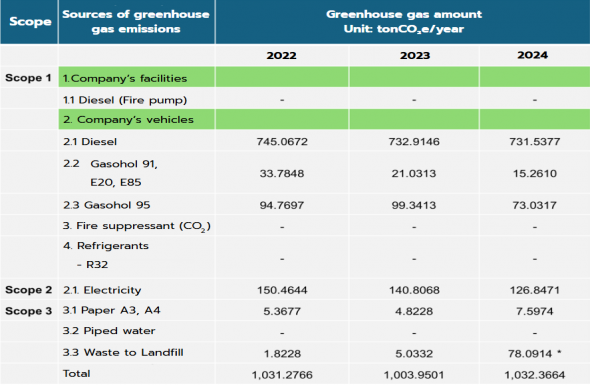
Greenhouse Gas Emission Comparison Result
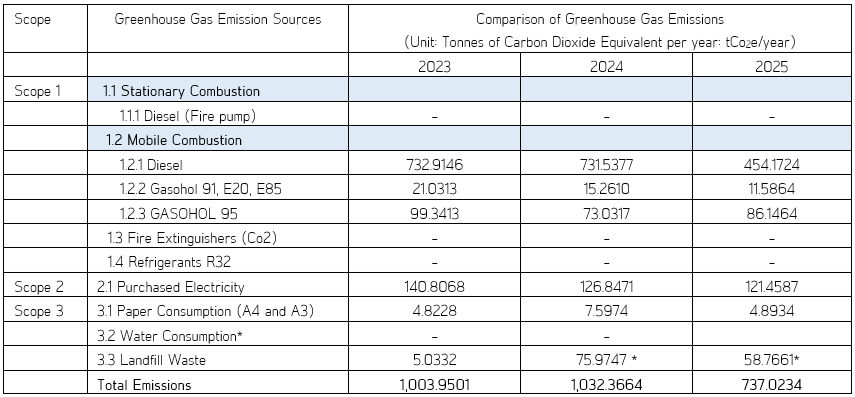
- Tap water costs for the office building of Premier Marketing Public Company Limited are collected by the building lessor and included in the service fees according to the lease agreement.
- The amount of waste sent to landfill increased in 2024 due to the disposal of damaged goods through landfill.
Note: Greenhouse gas emission data is specific to Premier Marketing Public Company Limited.
In 2025, Premier Marketing Public Company Limited and its subsidiaries assigned the Energy Conservation Working Group to study, communicate, and review data collection and recording standards. This initiative aims to ensure disclosure aligns with greenhouse gas (GHG) reporting guidelines within 2025, with the goal of enhancing energy and resource efficiency while further reducing environmental impact. In the past year, the GHG emissions specifically for Premier Marketing Public Company Limited totaled 737.0234 tCO2e/year. Compared to the 2024 base year, emissions decreased by 295.5343 tCO2e, or 28.60%. This significant reduction was primarily driven by a 32.68% decrease in fuel consumption and a 4.24% reduction in electricity usage compared to the same period last year.
Corporate Greenhouse Gas Emission Verification
P.M. Food Co., Ltd. recognizes the importance of establishing an organizational carbon footprint. We have consistently conducted assessments of our greenhouse gas emissions by monitoring seven types of GHGs. Activity data is collected annually to calculate the Carbon Footprint for Organization (CFO) and to prepare an assessment report in accordance with the reporting requirements. The monitoring period for this assessment is from January 1 to December 31, 2024. We seek verification at a limited level of assurance with a 5% materiality threshold, with the final CFO results to be certified by the Thailand Greenhouse Gas Management Organization (Public Organization) or TGO.
Target for 2025
To determine the organization's baseline greenhouse gas emissions for 2023 and to achieve registration for the corporate carbon footprint label.
Results Compared to Target 2025
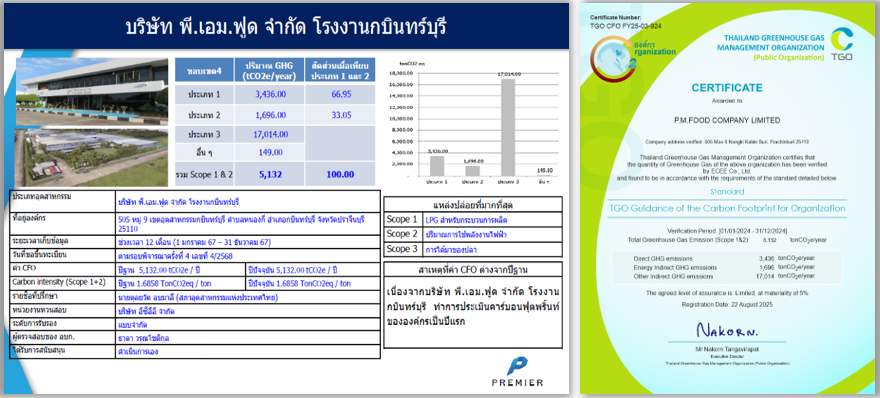
The greenhouse gas emissions for P.M. Food Co., Ltd. for the period of January 1 to December 31, 2024, are as follows:
- Scope 1 & 2: 5,132 tCO2e/year
- Scope 3: 17,014 tCO2e/year
The company has successfully achieved its target, with the results officially registered for the Carbon Footprint for Organization (CFO) label in accordance with the regulations of the Thailand Greenhouse Gas Management Organization (Public Organization).
Sustainable operations
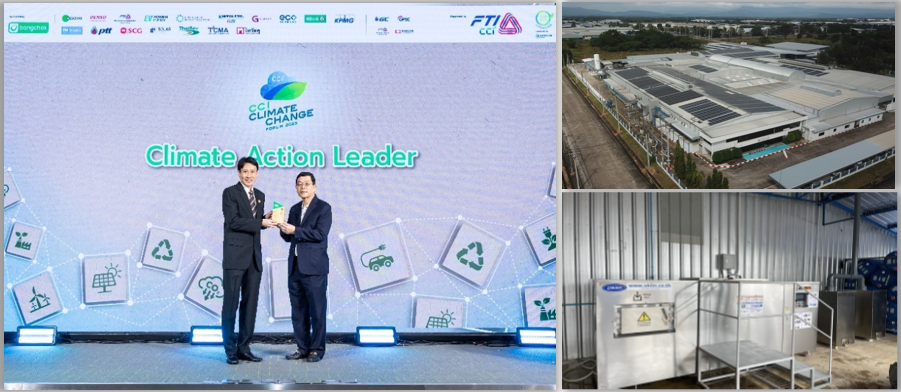
P.M. Food Co., Ltd. integrates ESG principles into its operations to enhance resource efficiency and mitigate global warming across the value chain. Our commitment to sustainable production of "Taro" fish snacks earned us the "Climate Action Leader" award from the Climate Change Institute (FTI) in September 2025, recognizing our excellence in resource management.
- Solar Rooftop to serve as a clean energy substitute, aiming to offset electricity usage from the national grid.
Energy Efficiency Targets
- January – June 2025: Target a 22% reduction in electricity consumption, equivalent to a monthly cost saving of 360,000 THB.
- July – December 2025: Target a 28% reduction in electricity consumption, equivalent to a monthly cost saving of 460,000 THB, while further reducing CO2
Key Results and Achievements
- Total Electricity Cost Savings: 5,102,429 THB (averaging 425,202 THB per month).
- GHG Emissions Reduction: Achieved a total reduction of 594.88 tCO2e (averaging 49.57 tCO2e per month).
- Management of production waste and factory food waste.
- The company converts waste into organic fertilizer to reduce landfill volumes and mitigate environmental pollution. Furthermore, we encourage employees to utilize this organic fertilizer, supporting the Circular Economy through the 3R principles: Reduce (minimizing unnecessary resource consumption), Reuse (optimizing resource utility through repetitive use), and Recycle (selecting materials that can be reprocessed for new use).
Through our waste-to-value initiative, P.M. Food Co., Ltd. converted 12,675 kg of production waste into organic fertilizer, strictly adhering to the 3R principles. This project saved employees 190,125 THB in expenses and achieved a 100% waste diversion rate for production and canteen waste (24 tonnes/year) by supporting local learning centers in Sa Kaeo. Most importantly, these efforts resulted in a total GHG reduction of 55.68 tCO2e annually.
Assessment of Ecosystem Biodiversity Value
Meewana Co., Ltd., a member of the Premier Group of Companies, has been operating an organic coffee business since 2012. It promotes organic coffee farming among farmers in Chiang Rai Province under the Forest-Conserving Organic Coffee Project and purchases all produce from certified organic farmers for processing and distribution. The company aims to be a social enterprise, focusing on economic development and strengthening agricultural communities while simultaneously conserving and restoring forest ecosystems. Its operations cover three headwater areas in Chiang Rai Province: the Mae Lao, Mae Suai, and Mae Korn watersheds. As of 2023, the Forest-Conserving Organic Coffee Project encompasses a total area of 4,671.25 rai and includes 278 farming families from 7 villages across 4 sub-districts in 3 districts of Chiang Rai Province. The project operates in two main ways:
(1) Growing coffee organically under the shade of existing conserved forest.
(2) Transforming pre-existing coffee farms into edible forests by planting additional trees to provide shade and enhance biodiversity.
As a result, the Forest-Conserving Organic Coffee Project has contributed to the conservation and restoration of thousands of rai of forest over the past decade. Simultaneously, it has generated an average annual income of 107,826 Baht per family for the 278 participating farming families. The company provides two additional types of premium payments: an organic premium averaging 11,014 Baht per family per year (representing 10.21% of the product value) and a shade-grown coffee premium averaging 2,519 Baht per family per year (representing 2.34% of the product value). These income figures are averages based on the coffee sales data from the most recent three years (2020-2022) for all farmers in the project.
Furthermore, Meewana Co., Ltd. contributes to community development funds for the producer groups, calculated at a rate of 0.50 Baht per kilogram of fresh coffee cherries sold by the farmers in the project to the company. This amounts to an average of 547,365 Baht per year (representing 1.83% of the product value). These funds are used for the development and empowerment of the groups and communities, such as building or providing public utilities like road construction and repair, building sports fields to reduce drug abuse in the community, installing streetlights, and providing fans in community gathering centers.
Moreover, the Forest-Conserving Organic Coffee Project helps mitigate conflicts between government officials and villagers regarding forest encroachment and destruction. Government officials report that coffee-farming villagers are the ones who actively urge officials to jointly create firebreaks at the start of the dry season, as wildfires could damage their coffee crops. They also collaboratively organize continuous reforestation activities in the coffee farms every year since 2013, having planted over 120,000 trees to date.
Therefore, Meewana Co., Ltd. seeks to understand the economic value of the forest conserved under the Forest-Conserving Organic Coffee Project. To this end, it has collaborated with the Biodiversity-Based Economy Development Office (Public Organization) or BEDO to assess the ecosystem service value of the forest in the area. Dr. Pongsak Witthawatchutikul, an ecosystem service valuation expert from Siam Cement Public Company Limited and former expert in headwater conservation and management at the Department of National Parks, Wildlife and Plant Conservation, serves as an advisor and provides knowledge on data collection methods for valuation using a model developed by Dr. Pongsak. The organic agriculture promotion team in Chiang Rai Province from Meewana Co., Ltd. collected data in April-May 2023 and analyzed the results following the guidelines learned from Dr. Pongsak, according to the detailed steps below.
Data Collection
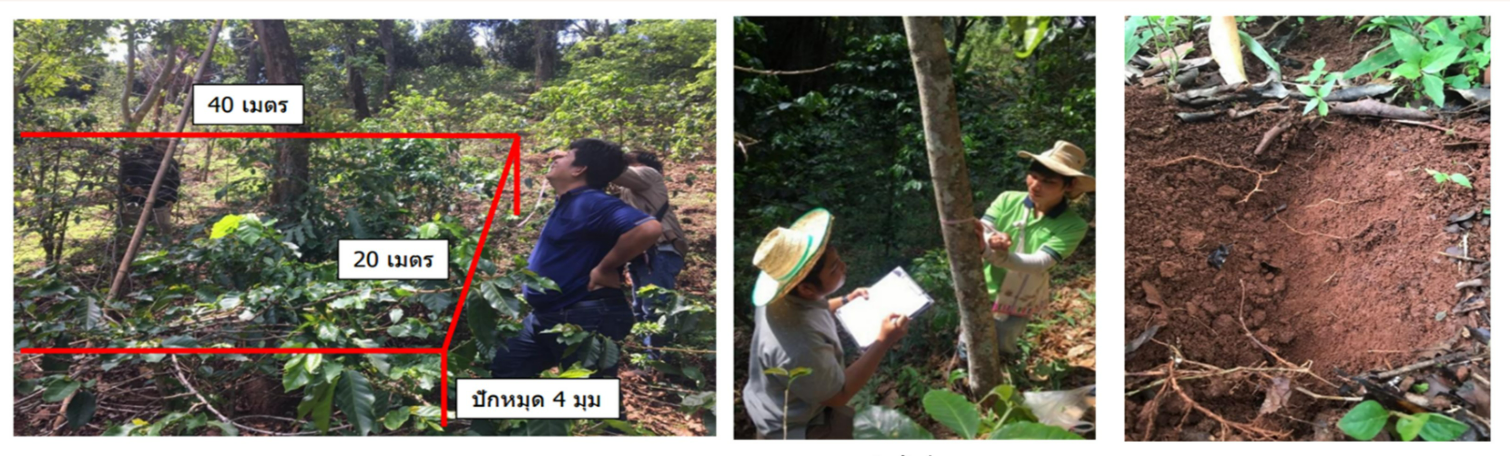
Study areas were selected to represent the entire project area, which consists of mountainous headwater regions with steep slopes. Representative areas were chosen from the mountaintop, hillside, and lower slope areas due to their varying soil depth and forest richness. In each selected area, a 20x40 meter experimental plot was established, with the 40-meter side running parallel to the slope. Permanent markers were installed to monitor and evaluate changes in the biodiversity of the ecosystem over different periods of the project's implementation.
Preliminary Data Analysis
The collected data was initially analyzed following these steps:
(1) Assessing the percentage of canopy cover (CC).
(2) Assessing the canopy stratification (CS) score.
(3) Assessing the percentage of basal area of all trees per unit area (BA).
(4) Assessing supplementary data, which includes:
(4.1) Annual rainfall data (Ra).
(4.2) Topographic characteristics score (CNt).
"Biodiversity Valuation"
Assessment of the Value and Worth of Ecosystem Biodiversity
The outputs from the preliminary data analysis in points (1), (2), and (3), along with soil depth (SD) data and the data from point (4), were input into a model for assessing certain values and worth of the headwater ecosystem biodiversity, developed by the Department of National Parks, Wildlife and Plant Conservation. The model's operational steps include:
- Assessment of the Ecosystem Biodiversity Value Score (BDV)
- The model will use the output from point (1) to assess the value and worth of the headwater forest ecosystem's biodiversity.
Valuation of Ecosystem Services in the Forest-Conserving Organic Coffee Project Area
Meewana Co., Ltd. divided the area for ecosystem service valuation within the Forest-Conserving Organic Coffee Project into three headwater forests: the Mae Lao headwater forest, the Mae Suai headwater forest, and the Mae Korn headwater forest. Each headwater forest area will be assessed according to the shade-grown coffee criteria established by the company, which are divided into four levels based on the diversity of tree species and shade cover, ranging from Level A (most diverse and shaded) to Level D (least diverse and shaded), as detailed below:
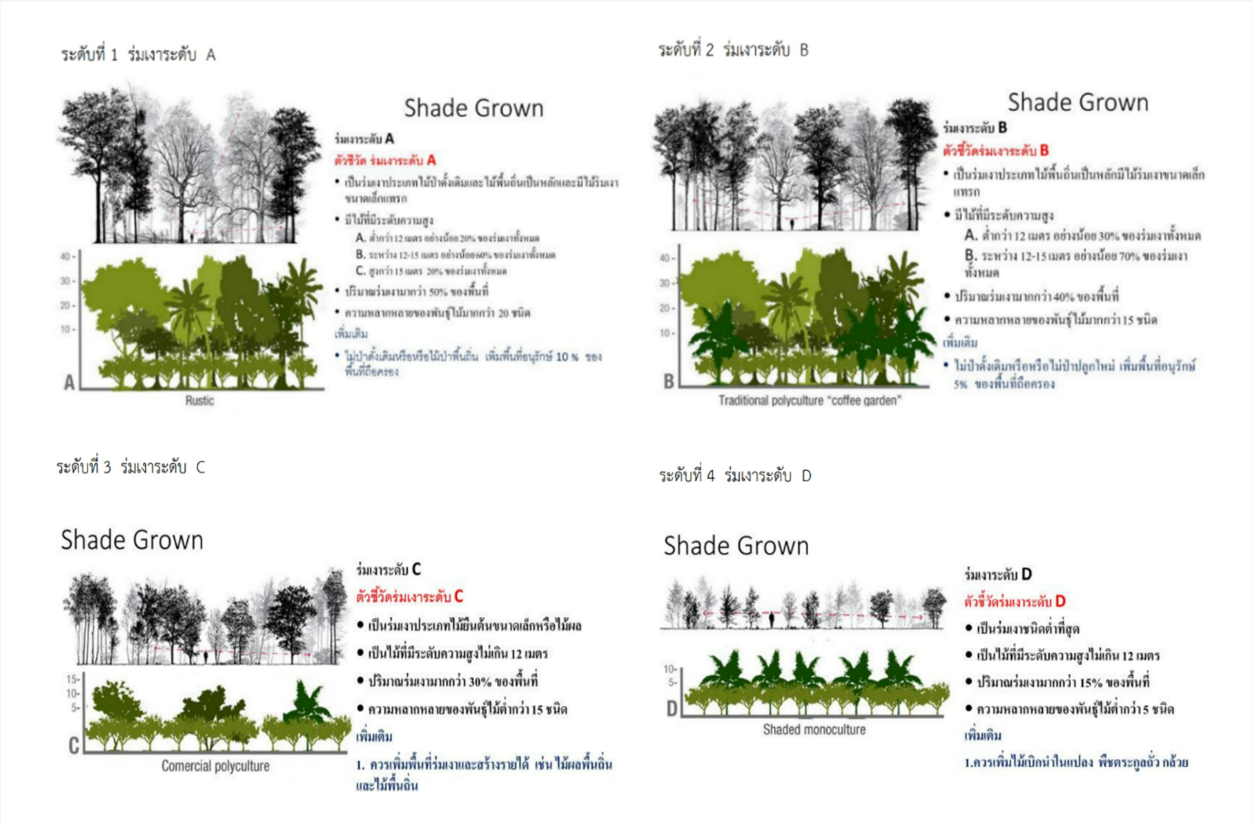
"Diversity of Tree Species A-D"
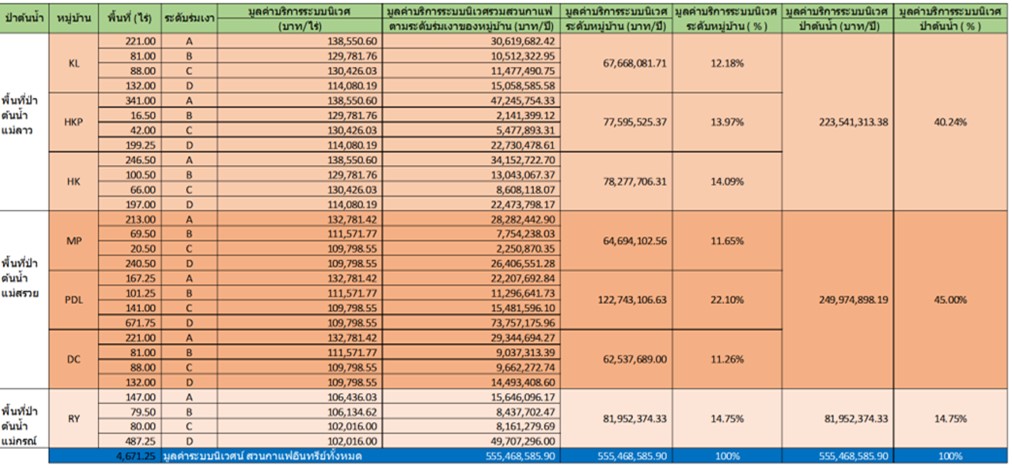
Summary of Ecosystem Service Value of the Meewana Forest-Conserving Organic Coffee Project Area
The total area of 4,671.25 rai is valued at 555,468,585 Baht per year, or an average of 118,912 Baht per rai per year. This is broken down by headwater forest area as follows:
- Mae Lao Headwater Forest Area: 1,730.75 rai, valued at 223,541,313 Baht per year.
- Mae Suai Headwater Forest Area: 2,146.75 rai, valued at 249,974,898 Baht per year.
- Mae Korn Headwater Forest Area: 75 rai, valued at 81,952,374 Baht per year.
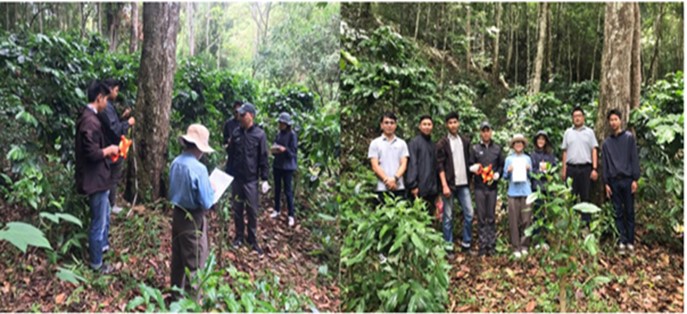
The data in the aforementioned report has been verified by officials from the Biodiversity-Based Economy Development Office (Public Organization) or BEDO, who conducted the verification on June 19, 2023. They verified the data measurement system of Meewana's staff regarding documentation, tools, and measurement methods. This included inspecting tree measurements, checking boundary distances, circumference, crown cover, and the area within the 800 square meter (20x40 meter) verification plot.
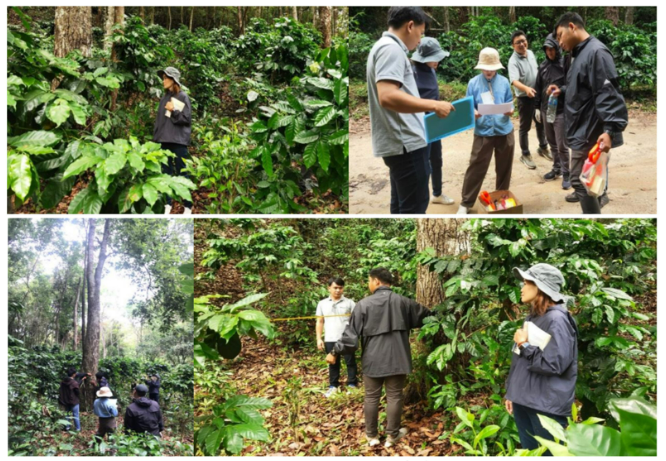
"Verification of the Ecosystem Services Valuation Project within the Project Area"
.png)
References
- Dr. Pongsak Witthawatchutikul. Methodology for Assessing the Value and Worth of Headwater Forest Ecosystem Biodiversity.
- Noppadol Chanruang, Kaeohatrai Samrongthong, Witchawisit Thirajraram, and Dr. Pongsak Witthawatchutikul. 2023. Concepts and Methods for Ecosystem Service Valuation (Payment for Ecosystem Services, PES) (of Shade-Grown Coffee Cultivation in Degraded Forests). Technical Document No. 1/2023. CSR/SCGC Social Enterprise.
ข่าวสารและกิจกรรม
Greenhouse Gas Mitigation 2024
Subsidiaries have mandated the Energy Conservation Working Group to oversee the study and communication of GHG guidelines. They are currently finalizing data collection and storage standards for disclosure within fiscal year 2024.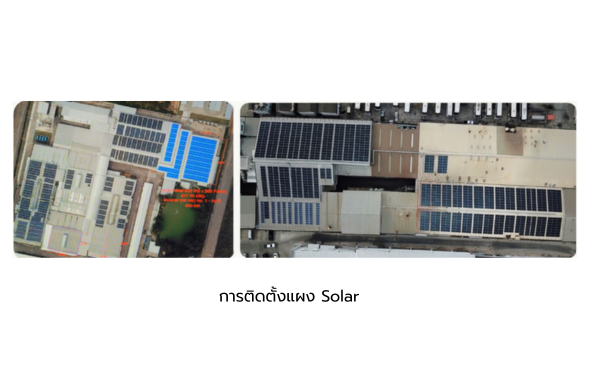
Use of Renewable and Clean Energy 2024
P.M. Food Company Limited and Premier Canning Industry Company Limited, both subsidiaries, have adopted a policy of conducting business with a commitment to responsible sustainability, particularly through the use of alternative energy.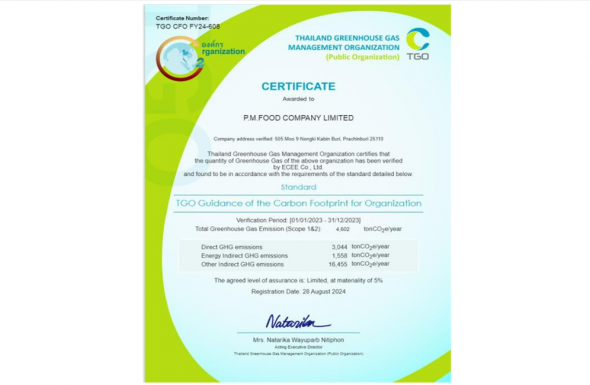
Carbon Footprint for Organization Certification 2024 from Thailand Greenhouse Gas Management Organization (Public Organization) or TGO.
P.M. Food Co., Ltd. Achieves Carbon Footprint for Organization Certification 2024 from TGO, Reinforcing Commitment to Sustainable Business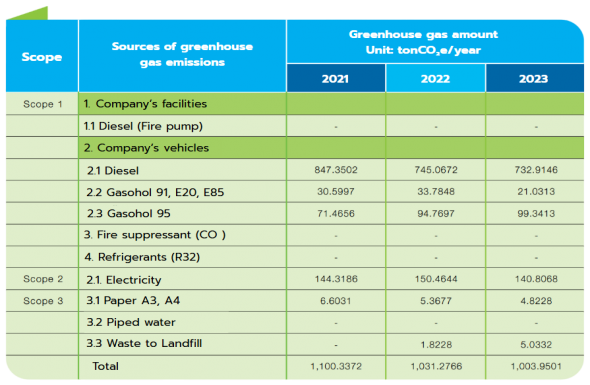
Greenhouse Gas Mitigation 2023
In 2023, the company set a target to reduce greenhouse gas emissions by 5%, which is equivalent to a reduction of 51.5638 tons of carbon dioxide equivalent, compared to the base year of 2022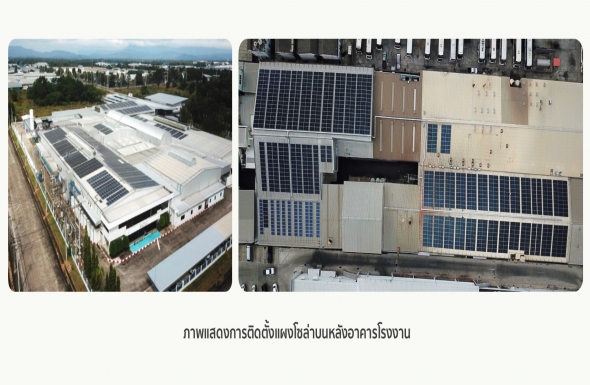
Use of Renewable and Clean Energy 2022
P.M. Food Co., Ltd. and Premier Canning Industry Co., Ltd., which are subsidiaries, have adopted a policy and guidelines for conducting business with sustainable responsibility, which extends to the use of renewable energy.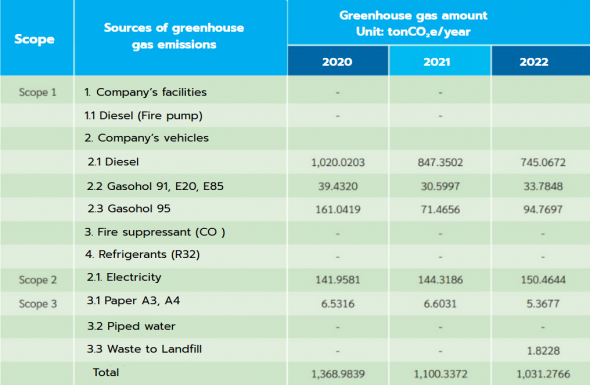
Greenhouse Gas Mitigation 2022
Premier Marketing Public Company Limited and its subsidiaries assigned the Energy Conservation Working Group to study, communicate understanding, and were in the process of reviewing the standards for collecting, storing, and recording data for disclosure according to greenhouse gas emission guidelines within fiscal year 2023. This was to further develop the efficiency of energy and resource utilization for cost-effectiveness and to reduce environmental impact.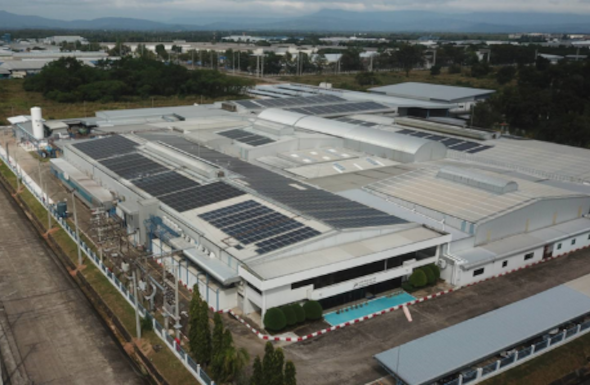
The Solar Roof expansion project for electricity generation from solar energy at P.M. Food Co., Ltd.
Image of the Solar Roof expansion project for electricity generation from solar energy at P.M. Food Co., Ltd. In August 2021, the investment in solar rooftops was further expanded by 740 Kw, with the installation of an additional 1,386 PV modules, bringing the total solar panel capacity to 810 Kw. This will enable the generation of 1,178 MWh of electricity per year, or 3,227 units/day.