
 Risk Management
To ensure the Company's sustainable growth, aligned with Premier Group's core mission of "Business Prosperity, Employee Security, Social Sustainability," risk management stands as a crucial factor for organizational success. It enables us to create business opportunities and mitigate the impact of potential business changes. Therefore, the Company has implemented the following risk management practices:
Risk Management Policy and Plan
-
The Company has implemented a comprehensive risk management system covering both Premier Marketing Public Company Limited and its subsidiaries. This system adheres to the ISO 31000:2018 risk management framework. This not only helps identify critical risks that could impact objectives or operational success and enhance company value, but also serves as a mechanism to respond to potential business changes. A key focus is placed on identifying significant risks that could affect the Company's business operations.
-
The Company recognizes that effective risk management requires support from employees at all levels. Therefore, a joint risk management working committee has been established to integrate risk management across the organization and ensure its application at every stage of operations, including preparing for potential changes.
-
The Company aims for all employees to recognize that risk management is an organizational culture that requires constant attention, rather than occasional action. To achieve this objective, the joint risk management working committee is tasked with overseeing the Company's risk management to ensure adherence to the Company's risk management manual.
On August 4, 2020, the Board of Directors resolved to appoint the Governance and Risk Oversight Committee. This committee is tasked with monitoring, verifying, evaluating, and advising the management of the Company and its subsidiaries on governance and risk management matters. Concurrently, management is assigned the responsibility for overseeing governance and risk management, driving their implementation across the entire organization.
Risk Management Structure
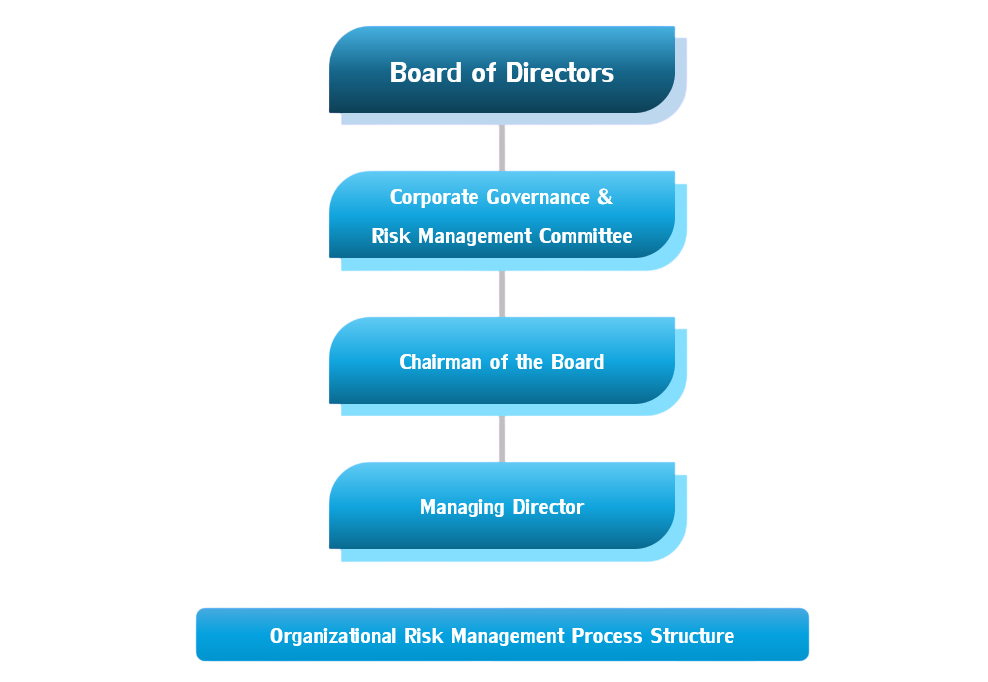
Roles and Responsibilities
- Board of Directors: Responsible for overseeing that the Company has a comprehensive risk management system and effective processes for risk management, reporting, and monitoring. The Governance and Risk Oversight Committee supports this by monitoring, verifying, evaluating, and advising the management on governance and risk matters. This includes the Managing Director and senior executives of both the Company and its subsidiaries.
- Chairman of the Executive Committee: Responsible for safeguarding the organization's core values and promoting business operations that align with these values, as well as with the Company's governance and risk management frameworks.
- Managing Director: Responsible for overall management, including monitoring business operations under the organization's core values, and overseeing the Company's governance and risk management.
The Company's risk management process is divided into two levels:
- Enterprise Level (Entity Level): At this level, the Company manages risks arising from core business activities, such as strategic risks, major plans, or management policies. This also includes risks from both internal and external factors that could significantly impact business operations.
- Activity Level: This involves managing risks that originate from the operations within each department. It covers risk factors related to work processes, equipment usage, technology, and personnel involved in the work.
Company Risk Management Framework
To ensure effective risk management for Premier Marketing Public Company Limited and its subsidiaries, a four-step risk management framework has been established:
- Risk Management Planning
- Risk Management Implementation
- Risk Management System Monitoring and Tracking
- Risk Management System Improvement
The Company and its subsidiaries designate responsible parties for assessing risks, defining preventive measures, and outlining response plans to manage risks to an acceptable level. They also continuously monitor and report on the results.
Types of Company Risks
To enable effective analysis, preventive measures, and response strategies for risk assessment across the Company and its subsidiaries, we have categorized risks into seven types:
- Compliance Risk: Risks related to adherence to laws, regulations, and internal policies.
- Financial Risk: Risks associated with financial stability, performance, and obligations.
- Strategic Risk: Risks that could impact the achievement of the Company's strategic objectives.
- Operational Risk: Risks arising from inadequate or failed internal processes, people, and systems, or from external events.
- Hazard Risk: Risks related to potential physical damage or unexpected events (e.g., natural disasters, accidents).
- Sustainability (ESG) Risk: Risks concerning environmental, social, and governance factors.
- Emerging Risk: New or evolving risks that are not yet fully understood or have unpredictable impacts.
Steps in the Risk Management Process
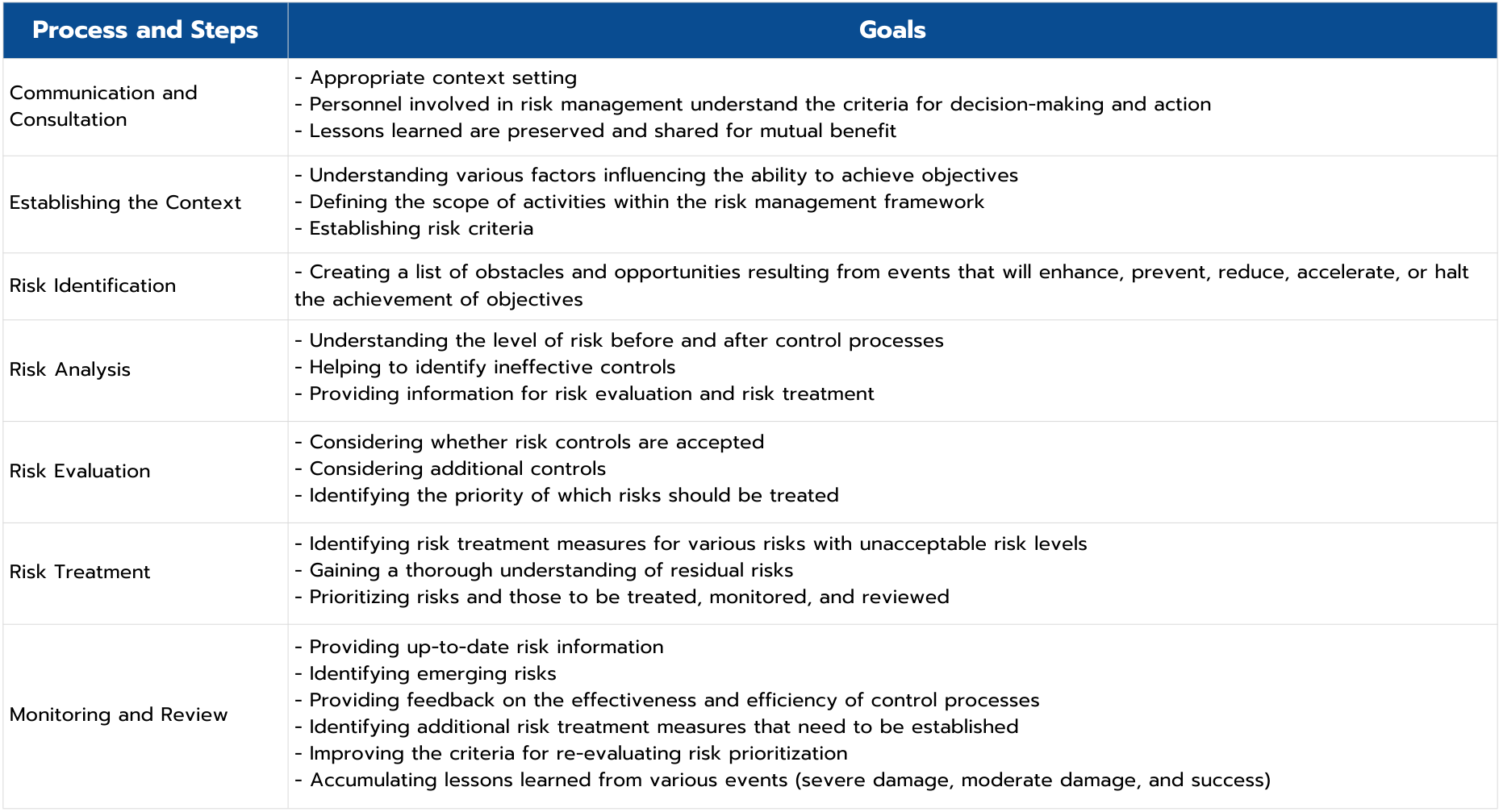
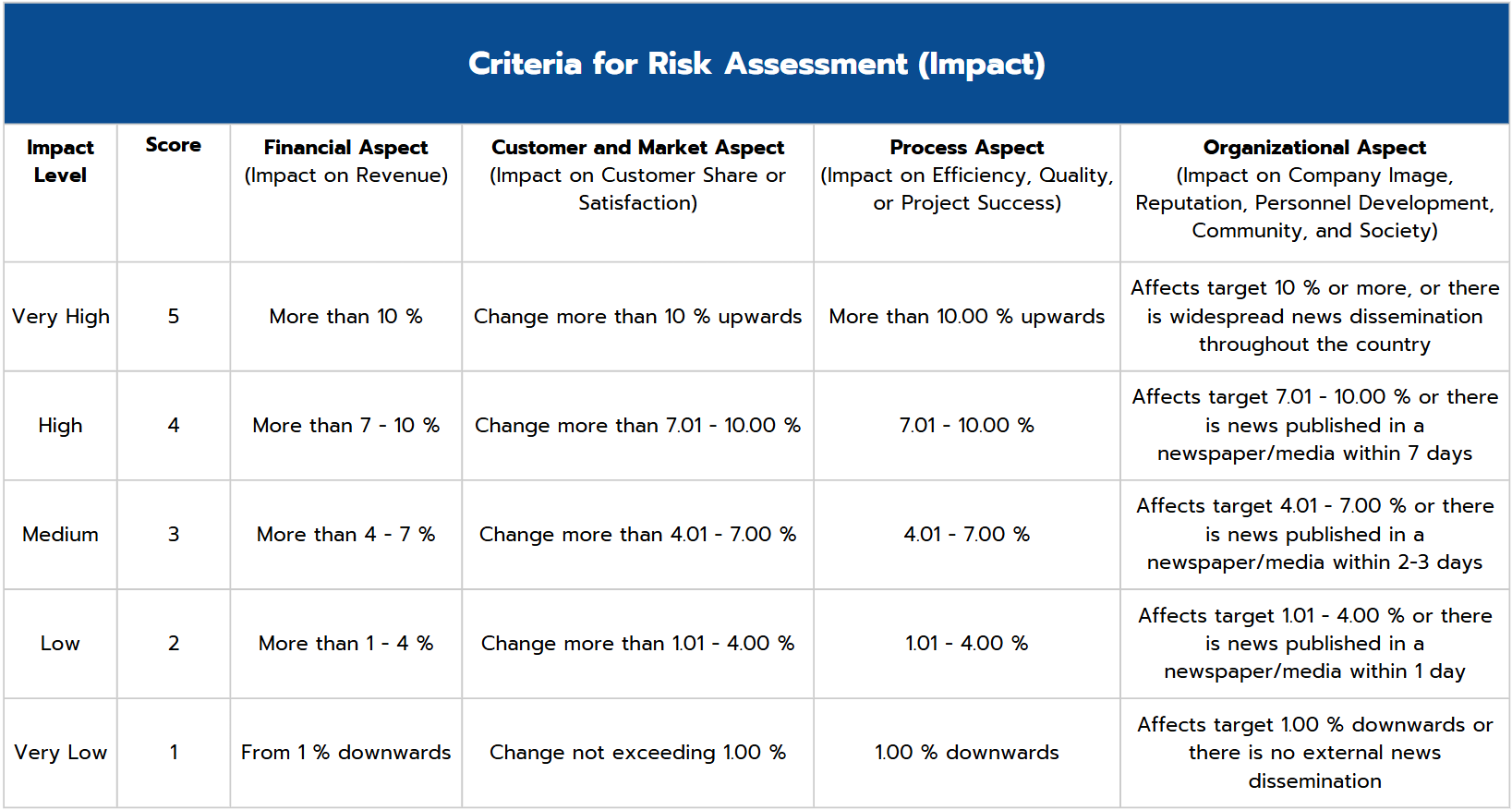
Criteria for Risk Assessment:
(1) Criteria for Assessing the Impact of Risk (Impact): This is categorized into four aspects, following the principles of the Balanced Scorecard, as follows:
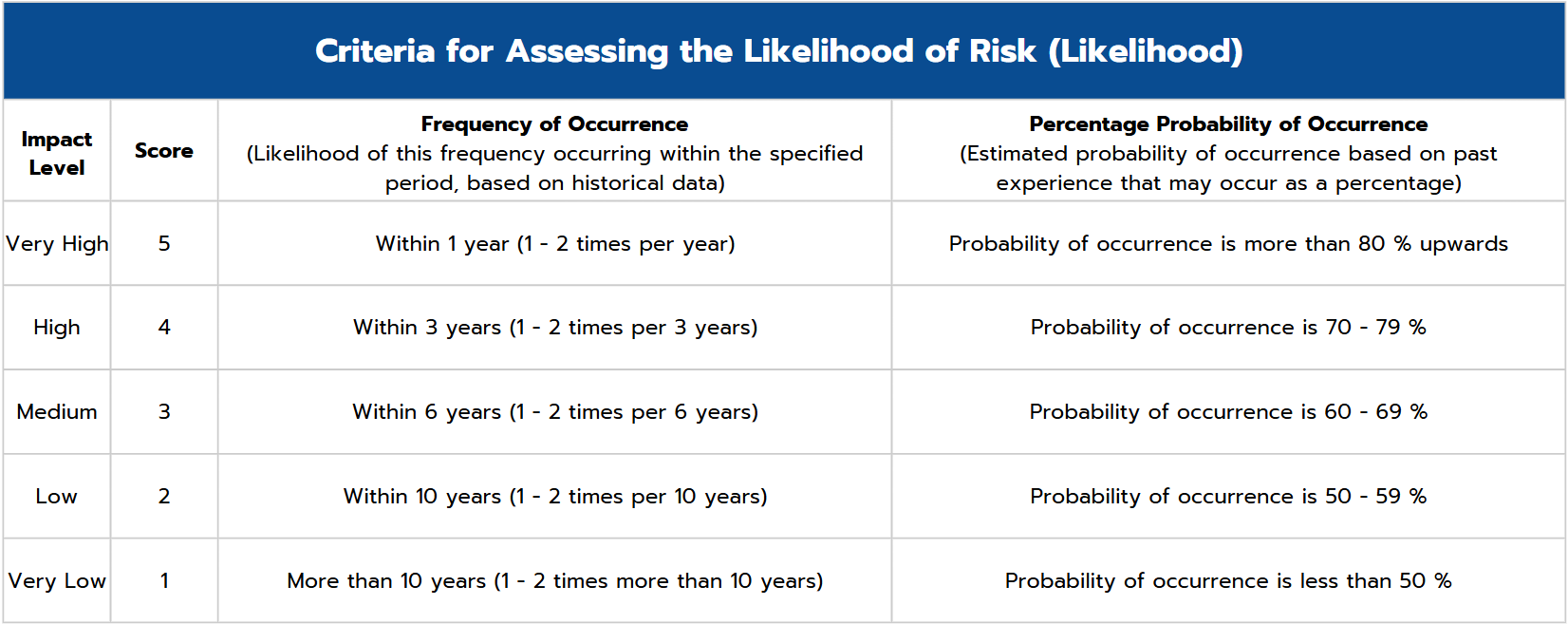
(2) Criteria for Assessing the Likelihood of Risk (Likelihood): This is categorized into four aspects, also following the principles of the Balanced Scorecard, as follows:
Determining the Risk Level
After calculating the risk level score, the obtained score is then used to determine the risk level within the Risk Matrix, as follows:
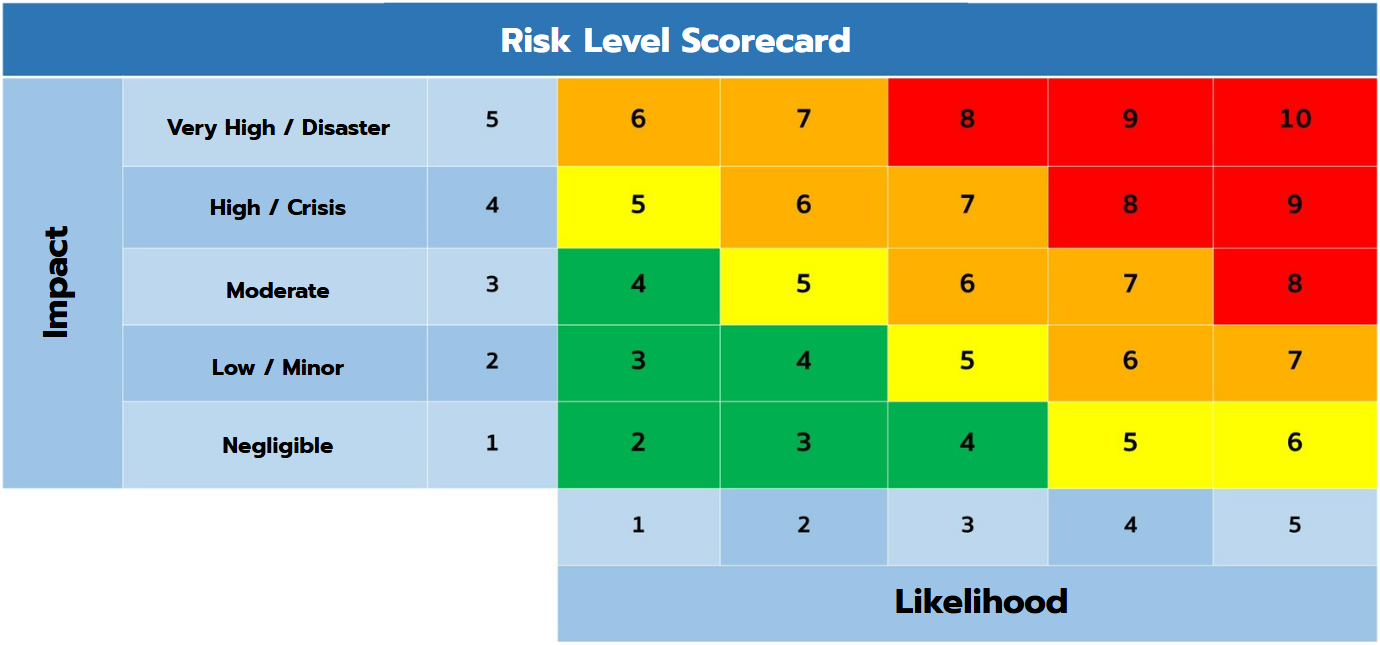
The Company and its subsidiaries emphasize raising awareness of risk management among the Board of Directors, management, and employees at all levels. This aims to promote and support the application of the risk management system in their work, which in turn helps create opportunities, mitigate impacts, and enable the organization to achieve its objectives and goals sustainably.
Environmental, Social, and Governance (ESG) Impact Risk Factors
Risks related to Environmental, Social, and Governance (ESG) Impact
- Risk from Natural Disaster Changes: The impact of the current global warming crisis has led to unpredictable weather patterns and various natural disasters, such as floods from rising sea levels. These events can cause disruptions and damage to the Company's business operations. Therefore, the Company has adopted a risk management approach that involves reviewing and preparing emergency plans to respond to emergency situations or crises. This includes reviewing and developing plans for product storage, avoiding flood-prone areas, and warehouse relocation plans, along with assigning responsible parties and consistently monitoring adherence to these plans. Furthermore, for inbound raw material and packaging transport, and outbound product delivery, the Company has developed alternative route maps in addition to the main routes for both inbound and outbound logistics.
- Risk from Forest Fires: Our subsidiary has invested in a business that produces and distributes organic Arabica coffee, in the form of roasted beans, ground roasted beans, and canned ready-to-drink coffee. We promote organic farmer groups who cultivate coffee under the shade of trees in legal watershed forest areas. This effort involves conserving and encouraging the planting of perennial trees to increase forestland. However, forest fires resulting from drought and illegal burning pose a significant risk to the coffee yield grown in these shaded forests. To mitigate this, we educate the farmer members within the project about potential impacts. We promote collaboration between government agencies and farmer groups to establish forest firebreaks in areas connected to and at risk of wildfires. Furthermore, we organize joint meetings with local community leaders to define measures and plans for controlling forest fires, and we encourage reforestation to enhance shade cover.
- Risk of Human Rights Violations and Unfair Labor Practices: Monitoring and assessing human rights risks is crucial, as various dimensions of risk can emerge, such as illegal labor practices or unfair employment conditions. These issues could lead to legal complaints, operational suspensions, and significant reputational damage for the company. Currently, the Company has mechanisms in place to monitor and assess human rights risks and impacts. We've also developed a comprehensive Human Rights Due Diligence Manual, which is disseminated to all executives and employees. Furthermore, we've implemented a Human Rights Due Diligence Process and labor practice reviews, including quarterly risk meetings with management to assess these issues. As of 2023, the Company has no significant disputes with stakeholders and has not identified any human rights violations.
- Risk of Violating the Personal Data Protection Act (PDPA): Personal data is considered a significant risk that organizations must manage appropriately. If data-holding entities fail to protect it, malicious actors or ill-intentioned individuals could misuse this information, leading to a loss of organizational credibility. The Company recognizes the importance of protecting the personal data of its employees, customers, and various stakeholders that it collects, uses, discloses, and transfers. Therefore, the Company has established a Personal Data Protection Policy, communicated and announced it broadly, and provided training to employees to ensure they understand the policy and relevant PDPA laws concerning data collection, use, and disclosure. The objective is to enhance the stringency of the Company's information security and cybersecurity measures, as well as data security standards, to ensure operations comply with the Personal Data Protection Act (PDPA). This includes, for example, establishing a Data Protection Officer (DPO) and implementing systems for collecting personal data across all channels (e.g., Cookie and Consent Management).
- Risk of Supplier Non-Compliance: The Company places great importance on conducting business ethically, adhering to its social responsibilities and stakeholder commitments based on sound corporate governance. This includes operating sustainably with a focus on Environmental, Social, and Governance (ESG) principles. By doing so, we aim to enhance operational efficiency through transparent and fair procurement processes, setting a guideline for our suppliers regarding potential business risks. As part of our risk management measures, the Company conducts ESG On-site Audits of its suppliers. These audits cover key areas such as business ethics, labor practices and human rights, health and safety, environmental management within operational areas, and responsibility towards the community and society. This comprehensive approach is designed to foster sustainable business development throughout the Company's supply chain.
Emerging risk
- Decreased Snack Consumption Due to an Aging Society: The proportion of births, which will contribute to the future workforce, is currently declining, leading to a shrinking working-age population. Concurrently, the proportion of the population aged 60 and above is continuously increasing (now over 20%), signifying Thailand's complete transition into an aging society. This decreasing birth rate and growing elderly population inevitably impact society, the economy, and consumption patterns, which in turn affect market expansion and the business of fish snacks. In response, the Company has launched marketing communications that target older consumers and has introduced products catering to the health-conscious senior demographic, such as TARO Lite (30% reduced sodium) and TARO Alaska Pollock.