TOP
Sustainable Procurement 2021
Procurement of key raw materials for sustainability
The subsidiary utilizes key raw materials processed from marine resources, the company aims to promote the balanced and sustainable use of these resources. Therefore, it has adopted practices aligned with the IUU (Illegal, Unreported, and Unregulated) Fishing regulations to prevent, deter, and eliminate illegal, unreported, and unregulated fishing. This is achieved through collaboration with the company's producers and suppliers to implement traceability systems and enhance communication channels, allowing consumers to clearly identify the marine fishing grounds from which the ingredients in their product packaging originate. This aims to build greater confidence in the product and provide other important information.
To ensure that the company's procurement of key raw materials complies with the IUU system and enables comprehensive source verification, the company has taken the following actions:
Partner Selection Process
The company will consider lists of business partners from reliable sources and verify their operational history, resulting in a preliminary list of vetted raw material suppliers before any transactions. Subsequently, selected business partners must submit raw material samples for standard testing and provide verifiable certifications of aquatic animal capture. In the case of processed aquatic animals from overseas, legal import permits and clearly specified origins of the raw materials are required, along with a verifiable traceability system. Furthermore, a satisfactory factory audit is mandatory before a business partner can be officially selected.
Sustainable procurement of raw materials
Beyond ensuring the quality and accuracy provided by raw material suppliers, internal controls are also a critical factor in maintaining transparency and promoting sustainable operations across all processes.
- Non-Monopolistic Sourcing: We avoid exclusive reliance on a single raw material supplier (multi-supplier approach). This is to ensure a consistent supply of quality, legal, and standardized raw materials at a reasonable price sufficient for our production needs. This strategy also guarantees product availability throughout the year and supports fair market competition
- Transparent Procurement: Transparency is a fundamental principle. Therefore, the company has established a Purchasing Committee comprising representatives from various departments such as Product Development, Quality Control, and Production. This committee collaboratively sources and makes decisions to ensure quality standards are met at every stage and to mitigate the risk of corruption.
- Adherence to Good Governance: In conducting our business, the company adopts and implements practices with fairness and accountability, based on mutual benefit. We avoid exploiting business partners and actively encourage them to operate according to the principles of good governance to foster shared sustainability for business, society, and the environment.
Raw material inspection process
For the procurement of raw materials for production, the company conducts quality checks before use to ensure confidence. This includes physical inspections, sensory evaluations, and texture tests, with samples sent to the company's internal laboratory for chemical and microbiological analysis. Additionally, suppliers must provide quality analysis reports and certifications of aquatic animal capture covering every production batch. This is to verify that business partners do not supply raw materials that violate IUU (Illegal, Unreported, and Unregulated) fishing regulations.
- Operational Targets:
- To successfully meet the audit criteria and operate in accordance with the requirements of IUU (Illegal, Unreported, and Unregulated) fishing regulations, as inspected by the Department of Fisheries.
- To have business partners pass the standard audit and evaluation criteria and be included in the company's list of approved suppliers.
- To ensure consumers can access information displayed on every purchased product package.
- Outcomes Compared to Targets:
- All audit criteria were successfully
- Business partners successfully passed the standard audit and evaluation criteria and are included in the company's list of approved suppliers.
- Consumers have developed confidence in the transparency and traceability of all related processes and are aware of the origin of the key raw materials.
Sustainable packaging procurement
Procurement aimed at long-term business sustainability, Premier Canning Industry Company Limited, a subsidiary, is committed to researching and developing in collaboration with reputable packaging manufacturers who share a dedication to sustainability goals. This ensures that the various packaging materials used in the company's production consider social and environmental responsibility, promote maximum utilization, and enable resource reduction. Through the efforts and cooperation of packaging manufacturers, the company has adopted new types of packaging that will continue to support the business's sustainability initiatives in the future.
- Guidelines for practice and results for packaging procurement are as follows:
- 1. Primary Packaging: Cans Reduced the thickness of the steel sheet used in can production from 0.16 to 0.15, in collaboration with can manufacturers who prioritize sustainable resource utilization as a model. For example, working with Swan Co., Ltd. to trial the thinner cans through the filling, production, and transportation processes.
- 2. Secondary Packaging: Labels Secondary packaging utilizes paper sourced from certified sustainably managed forests. Following the successful use of FSC-certified paper in 2019, initially for labels, sleeve boxes, and inner boxes of the "Atlas Cat" brand (a Premier Canning brand), business partners were encouraged to adopt paper from planted forests. This initiative received a positive response from customers, leading to increased interest and adoption of sustainably sourced packaging offered by PCI. Interested and adopting customers include MPM and WERUVA.
- Operational Targets
- Primary Packaging: Collaborated with can manufacturers to study the feasibility of adjusting the steel thickness for Can sizes 211x106 and 211x109
- Secondary Packaging: Utilized 100% paper sourced from sustainably managed forests (FSC certified) for the "Atlas Cat" brand.
- Secondary Packaging: Utilized paper sourced from sustainably managed forests (FSC certified) for customer brands.
- Label 99%
- Offset Box 99%
- Shrink Film: Achieve a 100% reduction in Shrink Film thickness from 70 microns to 50 microns.
- Shrink Film Printing (Seaweed Sauce & Black Pepper Sauce KK): Transition the printing system from Gravure, which uses chemical solvents, to Flexographic, which uses water-based solvents, with a target of 100% implementation.
- Results Compared to Target
- Can size 211x106, 211x109: Steel sheet thickness adjusted from 0.16 mm to 0.15 mm.
- Packaging from planted forests (FSC), excluding the "Atlas Cat" brand, achieved 100% of the target.
- Packaging from planted forests (FSC) for customer brands, including both boxes and labels.
- Shrink film thickness reduction from 70 MIC to 50 MIC achieved 100% of the target.
- Transition of the Shrink KK Black Pepper Sauce printing system to Flexographic achieved 100%.
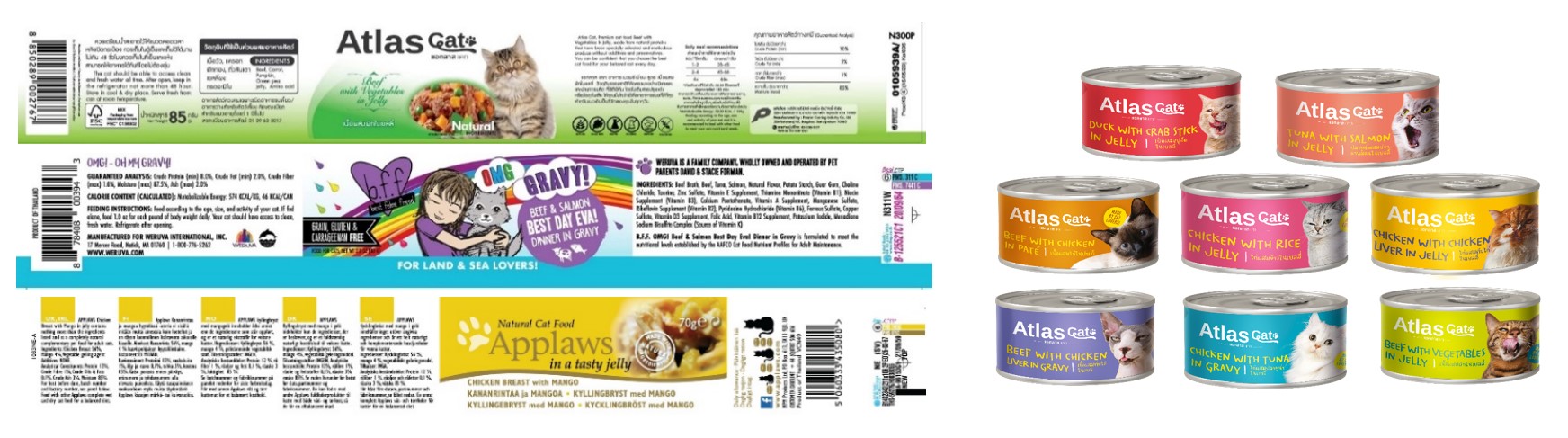
Example of the co-developed packaging.
Product Transparency and Traceability
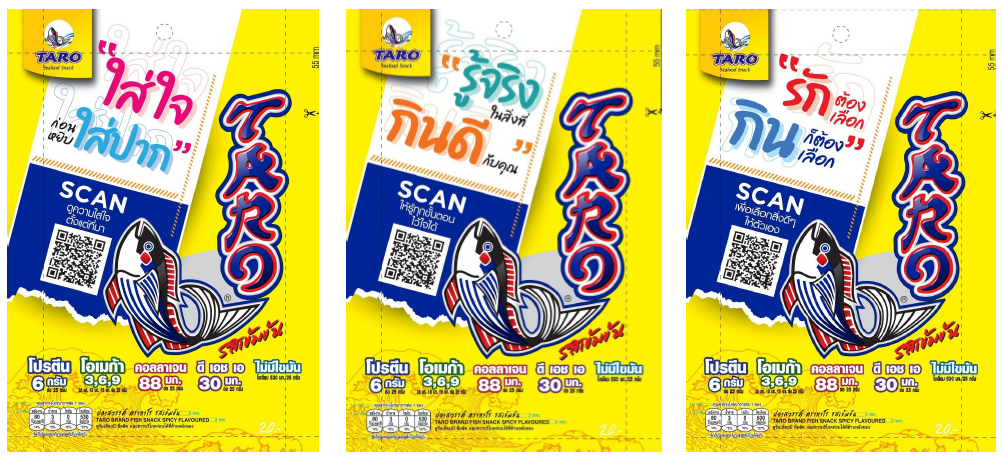
To demonstrate transparency in the production of Taro brand fish snack, a delicious and beneficial treat, we aim to highlight its nutritional value that surpasses consumer expectations. Beyond the product itself, our manufacturing process adheres to the same principles. Therefore, we are introducing the concept of conscious consumption by encouraging consumers to pay attention to the origin of ingredients and the production process. Taro is the first snack product to boldly present traceability to consumers, allowing them to understand the journey from the beginning of production until the product reaches their hands. This sets a precedent for the food industry in establishing production standards, ultimately benefiting consumers in making informed choices when selecting food products for consumption
Therefore, Taro prioritizes transparency in every process involved in sourcing its raw materials. This includes ensuring that the fishing of the raw fish is conducted legally and has received certification from the Department of Fisheries. This is to guarantee that the origin of the ingredients is handled correctly, is traceable, does not harm the environment, and considers sustainability.
.jpg)
The picture shows the steps to scan a QR Code using a mobile phone.
- Guidelines
Every package of Taro will feature a QR code that consumers can scan to access information about the origin of that specific product. Consumers will be able to know which waters the surimi used in the product they are consuming was sourced from. Complete traceability will be available for every package, allowing verification of the origin of all components throughout the production process. - Operational Target
Implement this across all Taro products, starting with all sizes and flavors of Taro Original in 2021, and expanding to all Taro product lines in 2022. - Outcome Compared to Target
The implementation for all sizes and flavors of Taro Original was completed in 2021, as scheduled.