TOP
Knowledge Development Leading to Model Farmers 2024
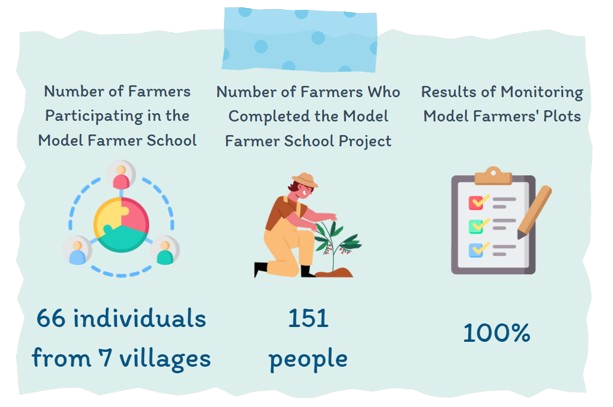
In line with the company's mission to continuously support creative ideas and drive development in all areas, and in accordance with its policy on business and social innovation management, the company collaborated with coffee-farming members of the Mee Wana Organic Coffee for Forest Conservation Project in Chiang Rai Province. In 2023, the company opened an area as a Model Farmer School. The objective was to sustainably improve coffee garden quality and efficiency through developing learning processes and systematically organizing shared knowledge. This facilitated exchange, as well as the transfer of knowledge and skills from extension officers and groups of coffee-farming members. The initiative utilized the principles of the Farmers Field School approach and guidelines for developing knowledge in coffee garden management with appropriate tools for each farmer's area, as follows:
- Selection of potential farmer members: From 7 villages, 85 farmers were selected. Their past 3 years of data were analyzed to identify strengths and weaknesses and assess their potential, in order to design individual development plans for each farmer.
- Setting production goals: Specific targets were set to increase yield per rai and improve the desired quality of the produce.
- Organizing learning processes: Development plans were established and organized for each individual farmer.
- Monitoring progress: The progress of each farmer's coffee garden development was continuously monitored.
Annual Performance Results 2024
Based on the summary provided by the extension officers during the small group exchange meetings among farmers, the findings are as follows:
- Farmers are prioritizing pruning and nurturing coffee plants more.
- Farmers are exchanging experiences in coffee garden development, which serves as a motivation for other farmers in the group to follow suit.
- Farmers are sharing knowledge and demonstrating proper fertilizer application based on assessments of the area, plant age, and soil conditions.
- Farmers are exchanging knowledge, comparing the differences in soil between organic and chemical farming plots.